Vaughn College hosted its annual Gala on April 16, recognizing five leaders whose work continues…
Zulu Pods Advances Emergency Oil Delivery Tech for Military Rotorcraft with Successful OEM Demonstration
In a compelling demonstration of innovation meeting mission-critical need, Zulu Pods, Inc. (ZPI) has successfully validated its EmergencyPOD (EPOD) technology at a major aerospace OEM facility, marking a significant step forward in emergency lubrication systems for military rotorcraft. The test, conducted on a bearing rig representative of a U.S. Army rotary-wing engine, showcased over an hour of sustained operation using ZPI’s handheld oil delivery system, designed to mitigate loss-of-lubrication (LoL) scenarios that can cripple aircraft mid-mission.
EmergencyPOD: A Tactical Response to Lubrication Failure
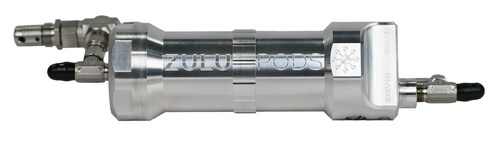
The EPOD system is engineered to deliver precision lubrication to critical components when an aircraft’s primary oil system fails. Lightweight and portable, the device is tailored for rapid deployment in field conditions or integrated into expendable engine architectures. According to the OEM’s program manager, the EPOD is “the most promising solution we’ve seen for loss of lubrication scenarios,” with potential for engine-level testing already under consideration.
This breakthrough aligns with the Department of Defense’s increasing emphasis on survivability and operational continuity in contested environments. LoL events, once considered catastrophic, are now being addressed through technologies that buy precious minutes, enabling safe landings, mission completion, or avoidance of hostile threats.
Collaboration and Context: A Multi-Stakeholder Effort
Zulu Pods’ progress is the result of a strategic partnership with DEVCOM AvMC and FirePoint Innovations at Wichita State University. Launched in 2023, the initiative reflects a broader push within defense R&D circles to enhance rotorcraft resilience and extend operational windows under duress.
The collaboration also highlights the growing role of university-affiliated innovation hubs in accelerating aerospace solutions. FirePoint, in particular, has emerged as a conduit between military needs and commercial ingenuity, fostering technologies that are both deployable and scalable.
Implications for Aerospace and Defense Stakeholders
For aerospace engineers and defense planners, Zulu Pods’ EPOD represents more than a clever workaround, it’s a paradigm shift in how lubrication is conceptualized in mission-critical systems. Traditional oil delivery mechanisms are often centralized and vulnerable. EPOD decentralizes that risk, offering a modular, fail-safe alternative that could be adapted across platforms, from helicopters to unmanned aerial systems.
Moreover, the technology’s potential applications extend beyond military use. Commercial aviation, space systems, and even industrial turbines could benefit from emergency lubrication strategies that prioritize minimalism, precision, and reliability.
From Rig to Rotorcraft
Zulu Pods is now eyeing engine-level testing, a move that would bring EPOD closer to full deployment. If successful, the system could be integrated into next-generation rotorcraft designs or retrofitted into existing fleets, enhancing readiness and reducing downtime.
As aerospace OEMs and military stakeholders continue to prioritize resilience and redundancy, technologies like EPOD will likely become standard components in future platforms. For now, Zulu Pods has positioned itself as a frontrunner in a niche but vital domain, where seconds matter, and innovation saves lives.

Related Posts