A Conversation with Jonathan Martin on the Future of Airspace As unmanned aircraft systems move…
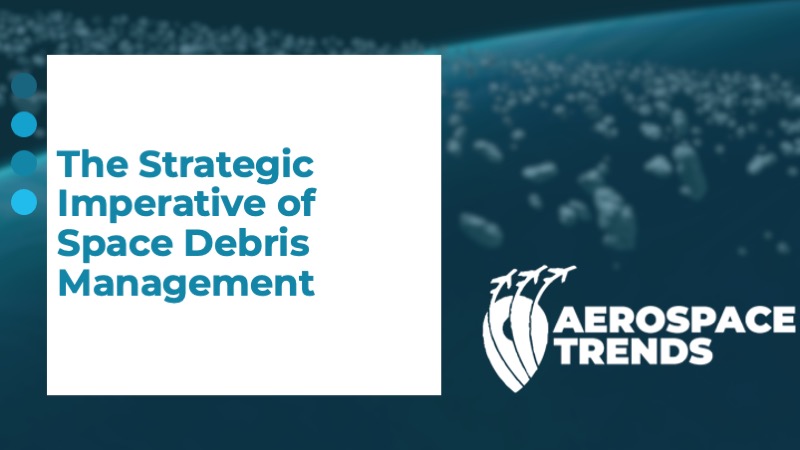
The Strategic Imperative of Space Debris Management
The global space economy is entering a period of unprecedented expansion, driven by proliferated satellite constellations, commercial launch cadence, and the rapid adoption of space based services across defense, telecommunications, climate monitoring, and mobility. This growth brings a parallel challenge that is no longer theoretical. Space debris has become one of the most significant strategic risks to orbital infrastructure, mission assurance, and long term commercial viability.
Executives across the aerospace sector now face a dual mandate. They must protect existing assets while preparing for a future in which orbital traffic increases by an order of magnitude. The organizations that treat debris mitigation as a core strategic capability rather than a regulatory obligation will be best positioned to compete in an increasingly congested domain.
The Scale and Trajectory of the Debris Problem
The debris environment has shifted from a manageable operational concern to a systemic risk. More than 36,000 tracked objects larger than 10 centimeters currently orbit Earth, with an estimated one million pieces between 1 and 10 centimeters that are too small to track but large enough to disable a satellite on impact (source: ESA 2024 report). The number of active satellites has grown from roughly 1,000 in 2010 to more than 9,000 today, and projections suggest that figure could exceed 60,000 by 2030.
This acceleration is driven by commercial constellation operators, national security space programs, and the democratization of launch access. The result is a dynamic environment where collision probability increases nonlinearly with object density. Even a single fragmentation event can generate thousands of high velocity debris fragments, each capable of triggering further collisions.
For aerospace executives, the implication is clear. Space debris is no longer a background risk. It is a strategic variable that influences spacecraft design, insurance costs, regulatory compliance, and long term business continuity.
Operational and Financial Impacts on Satellite Operators
The operational burden of debris avoidance is rising sharply. Satellite operators now conduct thousands of collision avoidance maneuvers each year, consuming fuel, reducing mission life, and increasing operational complexity. One major constellation operator reported more than 25,000 close approach alerts in a single year, a figure expected to grow as orbital density increases.
The financial implications are equally significant. Insurance premiums for satellites in low Earth orbit have increased as underwriters reassess risk exposure. Mission delays caused by debris avoidance can disrupt downstream services, from Earth observation data delivery to broadband connectivity. For defense operators, debris driven uncertainty complicates mission planning and increases the risk of degraded capability during critical operations.
Executives must therefore treat debris mitigation not as a cost center but as a strategic investment in resilience, predictability, and competitive advantage.
Regulatory Momentum and the Shift Toward Accountability
Governments and regulatory bodies are moving toward more stringent debris mitigation requirements. The United States Federal Communications Commission has adopted a five year post mission disposal rule for low Earth orbit spacecraft, replacing the previous 25 year guideline. International bodies are evaluating similar measures, and several nations are exploring financial penalties for non compliant operators.
This regulatory shift signals a broader trend. Spacefaring nations are increasingly unwilling to tolerate unmanaged debris growth. For aerospace companies, compliance is no longer sufficient. Demonstrating leadership in debris mitigation can influence licensing decisions, partnership opportunities, and customer trust.
Emerging Technologies for Debris Prevention and Removal
A new generation of technologies is emerging to address debris at multiple points in the mission lifecycle. These innovations fall into three primary categories: prevention, tracking, and removal.
Prevention Through Smarter Spacecraft Design
Spacecraft are being redesigned with debris mitigation in mind. Innovations include:
- Low mass, low fragmentation materials that reduce debris generation during failure events
- Autonomous collision avoidance systems that reduce operator workload
- Propulsion systems optimized for rapid deorbit at end of life
- Modular architectures that allow component replacement rather than full spacecraft retirement
These design choices reduce long term debris risk and align with evolving regulatory expectations.
Tracking and Space Domain Awareness
Accurate tracking is foundational to debris management. New capabilities include:
- Ground based radar and optical networks with higher sensitivity
- Space based sensors capable of detecting sub centimeter debris
- AI enabled conjunction analysis tools that improve prediction accuracy
- Data fusion platforms that integrate commercial, civil, and defense tracking sources
Improved tracking reduces false alarms, enhances maneuver planning, and supports more efficient fleet operations.
Active Debris Removal and On Orbit Servicing
Active debris removal is transitioning from experimental to commercially viable. Several companies and national programs are developing systems capable of capturing, towing, or deorbiting debris objects. Technologies include:
- Robotic arms for controlled capture
- Harpoon and net based systems for non cooperative targets
- Ion beam shepherding for contactless maneuvering
- Tethered deorbit devices for large objects
On orbit servicing is also emerging as a complementary capability. Refueling, life extension, and repair services reduce the need to launch replacement satellites, thereby slowing debris growth.
One major program plans to conduct its first operational debris removal mission by 2026, marking a significant milestone for the industry (source: industry program announcement 2024).
Market Forces Driving Investment and Adoption
The market for debris mitigation technologies is expanding rapidly. Analysts estimate that the global space sustainability market could exceed 2 billion dollars annually by 2030, driven by regulatory pressure, constellation scale, and the rising cost of inaction (source: industry forecast 2024).
Three forces are shaping investment decisions:
- Risk concentration Large constellations amplify exposure. A single collision can disrupt hundreds of satellites, creating cascading operational and financial impacts.
- Customer expectations Government and commercial customers increasingly require sustainability commitments as part of procurement evaluations.
- Competitive differentiation Operators that demonstrate superior debris mitigation practices gain regulatory goodwill, insurance advantages, and reputational benefits.
Executives who align their strategies with these forces will be better positioned to capture emerging opportunities.
Organizational Implications for Aerospace Leaders
Space debris management is no longer a technical issue delegated to engineering teams. It is a cross functional strategic priority that touches operations, finance, regulatory affairs, and corporate strategy.
Key organizational implications include:
- Investment planning Companies must evaluate debris mitigation technologies as part of long term capital allocation, not as discretionary add ons.
- Partnership strategy Collaboration with tracking providers, servicing companies, and regulatory bodies is essential to shaping standards and ensuring interoperability.
- Operational readiness Fleet operators must build processes and staffing models that support high tempo conjunction management.
- Reputation and stakeholder engagement Demonstrating leadership in sustainability strengthens relationships with customers, investors, and regulators.
Executives who integrate debris mitigation into enterprise level decision making will be better equipped to navigate the evolving space environment.
The Path Forward for a Sustainable Orbital Economy
The future of the orbital economy depends on the industry’s ability to manage debris proactively and collaboratively. The technologies exist, the regulatory momentum is building, and the commercial incentives are increasingly aligned. What remains is coordinated action across the aerospace ecosystem.
Companies that lead in debris mitigation will not only protect their assets but also shape the standards, partnerships, and market structures that define the next decade of space operations. The organizations that treat space sustainability as a strategic pillar rather than a compliance requirement will be the ones that thrive in a more crowded, contested, and commercially vital orbital environment.
The challenge is significant, but so is the opportunity. The aerospace sector has the chance to build a safer, more resilient, and more sustainable foundation for the next generation of space innovation.

Related Posts