Vaughn College hosted its annual Gala on April 16, recognizing five leaders whose work continues…
Continuous Composites Advances Simulation of Anisotropic Materials Under $1.9M U.S. Air Force TACFI Contract
Continuous Composites (CCI) has secured a $1.9 million Tactical Funding Increase (TACFI) contract from the U.S. Air Force to develop a next-generation Finite Element Analysis (FEA) tool tailored for anisotropic composite materials. The project, which began in November 2024 and runs through August 2026, aims to revolutionize how engineers simulate and predict the behavior of parts made using Continuous Fiber 3D Printing (CF3D), a technology with growing relevance in aerospace, defense, and UAV applications.
Bridging the Simulation Gap for Fiber-Steered Composites
Traditional FEA tools are optimized for isotropic materials like metals, which behave uniformly under stress. CF3D composites, however, are anisotropic, meaning their strength varies depending on fiber orientation. This directional complexity has posed a challenge for existing simulation platforms, which typically assign a single directional property per layer.
“We’re solving a major gap in FEA simulation tools,” said Steve Starner, CEO of Continuous Composites. “Our new tool will accurately simulate how our parts behave under various conditions, which is crucial for industries like aerospace and defense.”
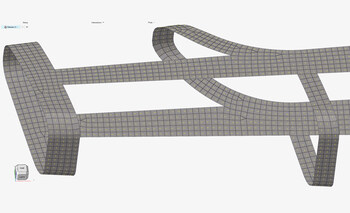
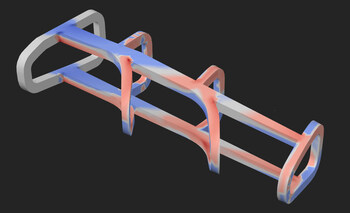
The new FEA tool will ingest CF3D toolpath data to generate mesh representations that reflect true fiber orientation and material behavior. This will allow engineers to predict performance before physical testing, reducing development time and increasing reliability in mission-critical applications.
Simulation Meets Manufacturing Agility
The aerospace industry is increasingly reliant on advanced composites for lightweight, high-strength structures. Yet the ability to accurately simulate these materials has lagged behind manufacturing innovation. CCI’s effort to integrate simulation directly into its CF3D Studio™ platform represents a shift toward a design-to-performance workflow, where digital validation precedes physical prototyping.
This is particularly valuable for aerospace engineers working on complex geometries and load-bearing components, where fiber steering can dramatically influence performance. By enabling predictive modeling of anisotropic behavior, CCI’s tool could become a cornerstone for next-gen aircraft design and certification.
Strategic Implications for Aerospace Stakeholders
For aerospace OEMs, defense contractors, and R&D labs, the development of this FEA tool offers a path to more agile and accurate design cycles. The ability to simulate anisotropic composites with high fidelity could reduce the need for iterative testing, lower costs, and accelerate time-to-deployment for advanced airframes and UAVs.
As additive manufacturing and composite technologies converge, tools like CCI’s will be essential for unlocking the full potential of fiber-steered structures. The Air Force’s investment signals a broader recognition that simulation is not just a design aid, it is a strategic enabler of aerospace innovation.

Related Posts