Mobix Labs is advancing development and field testing of its AI‑enabled drone intelligence platform, a…
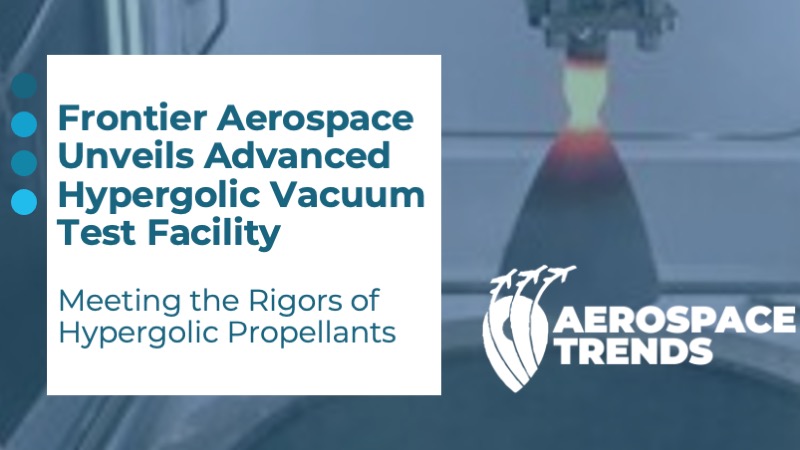
Frontier Aerospace Unveils Advanced Hypergolic Vacuum Test Facility
Frontier Aerospace has installed a new vacuum test stand designed specifically for hypergolic rocket engines at its headquarters near Houston. The cutting-edge facility will allow the company to qualify propellant combinations, validate ignition sequences, and characterize performance under high-altitude conditions closer to those encountered in space.
Meeting the Rigors of Hypergolic Propellants
Hypergolic propellants ignite on contact—a property that simplifies engine start sequences but also demands precise handling and rigorous safety protocols. Frontier’s new chamber supports both mono-propellant catalysts and bi-propellant mixtures, including nitrogen tetroxide and Aerozine-50, as well as emerging green hypergols. Integrated scrubbers, blast shields, and remote-handling tools ensure operator safety while maintaining rapid test turnaround.
Simulating High-Altitude Performance
Most engine tests on Earth carry the ambient pressure of sea-level air, masking critical behaviors such as flow separation and plume expansion that occur in near-vacuum. Frontier’s facility reaches pressures below one-tenth of a Pascal, replicating altitudes above 200 kilometers. This capability is essential for upper-stage engines and spacecraft reaction control thrusters, where precise thrust and restart characteristics determine mission success.
Accelerating Propulsion Development Cycles
In-house vacuum testing reduces reliance on external test centers, which can face scheduling bottlenecks and compatibility issues. By operating its own stand, Frontier can perform iterative evaluation of injector designs, materials screening, and ignition reliability tests on demand. Industry analysts at Teal Group estimate that such vertical integration can cut engine development timelines by 20 to 30 percent, translating to faster prototype delivery and earlier flight demos.
Positioning for Emerging Market Demands
The commercial space sector is shifting toward higher-value small-satellite deployments and rapid on-orbit servicing missions. Hypergolic thrusters play a key role in orbital insertion maneuvers and station-keeping maneuvers where restartability and fine-thrust control are paramount. Frontier’s investment signals confidence in the continued relevance of storable propellants even as low-toxicity alternatives and electric propulsion gain ground for smaller spacecraft.
Collaboration with Academic and Industry Partners
Frontier Aerospace plans to open the test stand to research institutions and propulsion startups under paid access agreements. Collaborative projects are already underway with the University of Central Florida’s propulsion laboratory to explore metal-organic hypergols and with a European nanosatellite developer testing hybrid interfaces. Such partnerships could drive innovation in propellant chemistry and injector architectures.
Looking Ahead in Propulsion Testing
As launch cadence increases globally, the ability to qualify engines rapidly and safely becomes a strategic advantage. Frontier Aerospace’s new hypergolic vacuum test stand positions the company to support both government missions and commercial operators seeking proven storable-propellant solutions. By marrying robust safety features with high-fidelity altitude simulation, the facility sets a new standard for engine development workflows in the era of mass access to space.

Related Posts