
Vaughn College hosted its annual Gala on April 16, recognizing five leaders whose work continues…
MacLean-Fogg and Fraunhofer ILT Push Boundaries of Additive Manufacturing with Record-Scale Die Casting Insert
MacLean-Fogg Company and the Fraunhofer Institute for Laser Technology ILT have delivered what is believed to be the world’s largest 3D-printed die casting tooling insert, 156 kilograms of nearly solid L-40 tool steel, for Toyota Europe’s Yaris hybrid transmission housing. While the achievement is rooted in automotive manufacturing, its implications ripple across aerospace tooling, structural casting, and high-performance materials engineering.
A Milestone in Large-Format Metal Additive Manufacturing
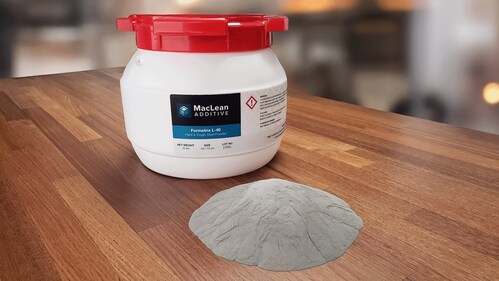
The insert was produced using Fraunhofer ILT’s gantry-type, multi-laser Laser Powder Bed Fusion (LPBF) system, a platform capable of processing parts over 50 centimeters in length at chamber temperatures up to 200°C. The build leveraged MacLean-Fogg’s proprietary L-40 tool steel powder, engineered for high hardness and toughness with minimal preheat requirements. This combination enabled the creation of a conformally cooled insert with extended durability and reduced maintenance intervals.
For aerospace stakeholders, the scale and material performance of this insert signal a new frontier in tooling for hot and cold forming applications. As the industry explores giga-casting and structural die casting for lightweight components, the ability to produce large, high-integrity inserts via additive methods could dramatically reduce lead times and expand design flexibility.
Material Innovation: L-40 Powder as a Strategic Enabler
MacLean-Fogg’s L-40 powder was developed specifically for LPBF applications, offering resistance to crack formation and propagation even under moderate thermal conditions. Compared to conventional tool steels, L-40 reduces aluminum soldering, doubles insert lifespan, and minimizes post-build heat treatment requirements. Its sustainability profile, free of cobalt and low in nickel, adds further appeal for aerospace programs focused on environmental compliance and supply chain resilience.
Dr. Harald Lemke, Director of Product Development at MacLean-Fogg, noted the challenge of scaling the process to meet Toyota’s specifications, particularly in managing consistent gas flow across large build volumes. The success of this project demonstrates the viability of L-40 for large-format tooling and opens the door to broader industrial adoption.
Aerospace Implications: From Automotive to Orbital Platforms
While the insert was designed for automotive die casting, the underlying technologies are highly relevant to aerospace manufacturing. Conformal cooling, hybrid build strategies, and large-format LPBF systems are increasingly used in rocket engine tooling, structural airframe components, and thermal management systems. Fraunhofer ILT’s gantry architecture and MacLean-Fogg’s material science could support future applications in satellite bus fabrication, propulsion system molds, and high-cycle fatigue tooling.
Dr. Niklas Prätzsch of Fraunhofer ILT emphasized that the gantry system was developed precisely to enable large-scale additive manufacturing at lower temperatures without compromising quality, a critical capability for aerospace-grade alloys and geometries.
Scaling Innovation Across Industries
The collaboration between MacLean-Fogg and Fraunhofer ILT reflects a broader trend toward cross-sector innovation in additive manufacturing. By validating large-format inserts with OEMs like Toyota, the partners are laying groundwork for similar breakthroughs in aerospace, energy, and industrial tooling.
Upcoming presentations at the NADCA Die Casting Congress and Formnext 2025 will showcase the technology’s potential, offering aerospace engineers and program managers a closer look at how additive processes can reshape tooling economics and performance.
For aerospace stakeholders seeking to reduce development cycles, enhance tooling longevity, and localize supply chains, this milestone offers a compelling case study in what’s possible when advanced materials meet next-generation manufacturing platforms.

Related Posts