Palantir Technologies has formed a strategic partnership with Ondas and World View to develop an…
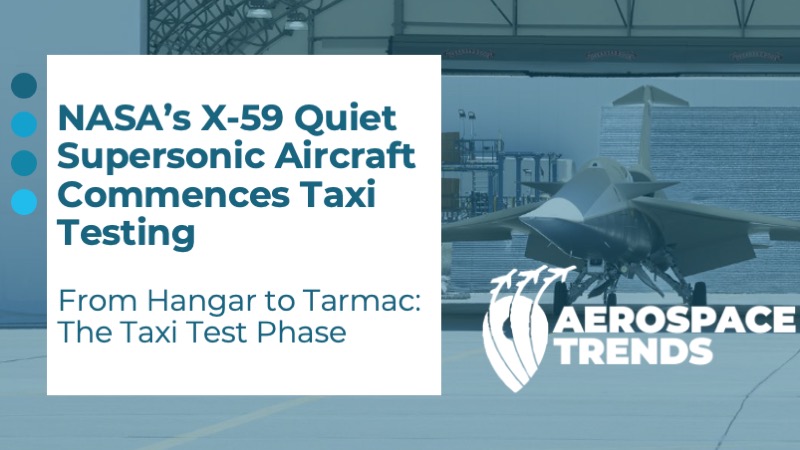
NASA’s X-59 Quiet Supersonic Aircraft Commences Taxi Testing
NASA’s experimental X-59 QueSST (Quiet SuperSonic Technology) aircraft has rolled onto the runway at Lockheed Martin’s Skunk Works facility in Palmdale, California, marking the start of its low-speed taxi test campaign. This milestone brings the X-59 one step closer to its goal of demonstrating that advanced shaping and design can drastically reduce the characteristic “sonic boom” into a gentle “thump,” potentially opening the door to routine civil supersonic flight over land.
From Hangar to Tarmac: The Taxi Test Phase
During taxi tests, the X-59 will undergo a series of ground runs at increasing speeds to verify steering responsiveness, brake performance, and overall handling characteristics. Engineers will collect data on the aircraft’s electronic flight-control systems and monitor vibration, acoustics, and structural loads. These tests are critical for validating the vehicle’s readiness for its first flight, currently scheduled for later this year.
Lockheed Martin test pilots will gradually build speed in a controlled environment, ensuring that all subsystems—ranging from its distinctive 30-foot-long nose to the single General Electric F414 engine—interact as predicted. Data from onboard sensors will feed back into the digital model, refining simulations for subsequent flight tests.
Implications for Supersonic Transport and Airspace Policy
Supersonic overland flight has been effectively banned in many countries due to the disruptive sonic booms produced by conventional high-speed aircraft. NASA’s X-59 program aims to change that narrative by proving that sonic signatures can be shaped into a low-intensity sound profile acceptable to communities beneath flight paths. If successful, regulators such as the Federal Aviation Administration and the International Civil Aviation Organization may update rules to permit supersonic routes across continental airspace.
For aerospace manufacturers and airline operators, the promise of overland supersonic travel could revolutionize route planning and fleet utilization. Short-haul routes plagued by lengthy layovers—such as transcontinental or intercontinental legs under four hours—could see new high-speed services. Aircraft design houses may accelerate work on clean-sheet supersonic airliners, leveraging lessons learned from the X-59’s advanced composite construction and innovative low-boom shaping techniques.
Charting the Next Mach Frontier
The X-59’s taxi debut represents more than a test-vehicle milestone; it signals a concerted push toward reclaiming supersonic capability for commercial aviation. While private ventures are exploring point-to-point hypersonic concepts, NASA’s focus remains on sustainable, community-friendly speeds around Mach 1.4. Achieving regulatory buy-in will require not only technical proof but also a robust framework for noise certification and community engagement.
Challenges remain in translating the X-59’s one-off design into a scalable production model. Manufacturing costs for ultra-low-boom airframes and certification hurdles for novel shapes could pose barriers to entry. Moreover, integrating low-noise supersonic aerodynamics with economic fuel burn and maintenance cycles will test the industry’s agility.
Still, the successful taxi testing of X-59 QueSST rekindles interest among airframers and civil regulators in the feasibility of supersonic travel. As NASA and Lockheed Martin proceed toward the first flight, aerospace stakeholders should prepare for a period of rigorous data analysis and policy dialogue. Should the “thump” meet community noise thresholds, the X-59 could mark the beginning of a new era—one in which crossing oceans at twice the speed of sound becomes as routine as today’s jet-powered transits.

Related Posts