Palantir Technologies has formed a strategic partnership with Ondas and World View to develop an…
Vertical Aerospace Nears Transition Testing Milestone for VX4 eVTOL
Vertical Aerospace has completed Phase 3 wingborne flight testing of its VX4 electric vertical takeoff and landing (eVTOL) prototype, marking a pivotal moment in its journey toward commercial certification. The full-scale aircraft has now flown in open airspace using wing-generated lift, validating its aerodynamic design and simulator performance under both manual and computer-assisted control modes.
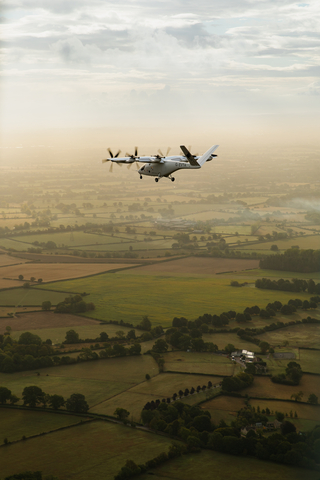
This milestone sets the stage for the final and most complex phase of testing: transition. The VX4 must now demonstrate seamless switching between vertical lift and wingborne flight, a defining capability for tiltrotor eVTOLs and a prerequisite for scalable urban air mobility.
A Quiet Leap Toward Scalable Electric Flight
The VX4’s wingborne mode is not just a technical achievement, it’s a strategic enabler. By flying like a conventional aircraft, the VX4 operates in a quieter, lower-power regime that supports practical, economically viable electric air travel. For aerospace stakeholders exploring sustainable regional transport, this capability could reshape how short-haul routes are served.
Chief Test Pilot Simon Davies and Test Pilot Paul Stone led the Phase 3 flights, reporting that the aircraft performed as modeled in simulations. Their work builds on Europe’s first-ever piloted wingborne flight of a winged eVTOL, completed by Vertical in May 2025.
Data-Driven Validation and Regulatory Momentum
Vertical’s test program has already logged over 250 miles of piloted flight, reaching speeds of 120 knots and altitudes of 2,000 feet. More than 22 billion data points have been collected, supporting validation of aerodynamic models, acoustic profiles, and system reliability.
The UK Civil Aviation Authority (CAA), in collaboration with the European Union Aviation Safety Agency (EASA), has extended Vertical’s Permit to Fly following a rigorous review. This dual-track regulatory engagement positions Vertical for concurrent certification across multiple jurisdictions, with type certification targeted for 2028.
Transition Testing: The Defining Challenge
The upcoming transition phase will test the VX4’s ability to shift between helicopter-like vertical lift and airplane-style wingborne flight. This hybrid mode is essential for real-world operations, allowing the aircraft to take off and land in confined spaces while cruising efficiently at altitude.
Vertical’s flight test team enters this phase with high confidence, backed by robust simulation tools and validated performance data. Success here would confirm the VX4’s readiness for passenger service and unlock new possibilities for advanced air mobility.
Strategic Leadership and Industry Partnerships
Vertical recently appointed Patrick Ky, former Executive Director of EASA, to its Board, joining a roster of influential leaders including Professor Scott Galloway, Sri Tony Fernandes of Air Asia, and Lord Parker, former Director General of MI5. Their presence underscores the company’s commitment to regulatory excellence and strategic growth.
The VX4 program also benefits from partnerships with aerospace heavyweights like GKN, Honeywell, and Aciturri. Vertical’s proprietary battery and propeller technologies complement these collaborations, supporting its goal of delivering the world’s safest and most advanced eVTOL.
Implications for Regional Aerospace Hubs
Vertical’s progress offers a glimpse into the future of regional air mobility. As hybrid-electric variants emerge and certification pathways solidify, local aerospace firms may find new opportunities in supply chain integration, pilot training, and infrastructure development.
Vertical’s journey is far from over, but with wingborne flight behind them and transition testing ahead, the company is rapidly approaching the threshold of commercial viability. The VX4 is no longer just a concept, it’s a machine in motion, gathering data, building trust, and redefining what electric aviation can achieve.

Related Posts