
Vaughn College hosted its annual Gala on April 16, recognizing five leaders whose work continues…
AM General, Carnegie Robotics and Textron Team on Army Modular UGV Development
AM General has announced a collaboration with Carnegie Robotics and Textron Systems to develop a modular unmanned ground vehicle (UGV) for the U.S. Army’s modernization efforts. The effort underpins a proposed solution for the Army’s Medium Modular Equipment Transport (M-MET) program, aimed at enhancing autonomous logistics and energy distribution capabilities in contested environments.
Modular, Multi-Mission Design
The joint effort focuses on a modular architecture capable of autonomous supply delivery, operational energy distribution, and integration of varied payloads. The vehicle will be built on a light tactical vehicle chassis enhanced with a hybrid powertrain that provides exportable power in excess of 30 kW, enabling the UGV to support both mobility and energy needs. Drive-by-wire controls, an autonomy software stack, sensor fusion, and a modular open system architecture are key technology elements in the design.
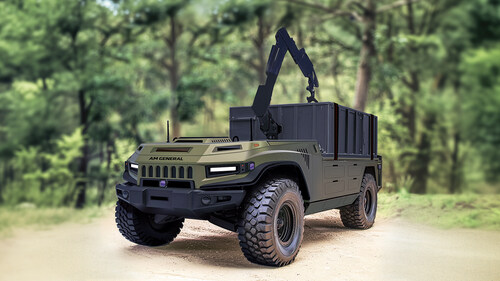
This architecture is intended to support adaptability across mission contexts, allowing for reconfiguration of payloads, sensors, and subsystems in response to evolving operational requirements. The goal is to close logistics gaps between brigade support areas and forward units with scalable autonomy and resilience.
Roles of Partners
- AM General will supply the rugged vehicle platform and leverage its experience in military ground mobility systems.
- Carnegie Robotics is responsible for autonomy software, perception, sensor fusion, the compute architecture, and payload integration systems.
- Textron Systems will contribute drive-by-wire systems, diagnostics, and payload control, drawing on its experience across unmanned systems.
Each partner brings domain strengths intended to accelerate development of a mature and fieldable solution for the Army’s modernization roadmap.
Significance for Defense and Aerospace Stakeholders
For aerospace and defense industry observers, this collaboration illustrates how terrestrial autonomy and energy subsystems architectures are converging with advanced control, networking, and sensor technologies common to aerospace systems. UGV developments often parallel lessons learned in unmanned aerial systems and autonomous flight, especially in autonomy stacks, modular payload integration, and robust communication systems.
The M-MET program underscores the Army’s increasing demand for integrated, cross-domain logistic solutions—particularly in multi-domain operations environments where ground mobility, energy sustainment, and autonomy overlap with aerospace reconnaissance, supply delivery, and command architectures.
This initiative may present opportunities for subcontractors specializing in sensors, power electronics, embedded computing, autonomy middleware, ruggedization, and systems integration to align with ground vehicle and cross-domain mobility programs.
Outlook
The request for proposal for the M-MET program is expected in 2026. As development proceeds, the collaborative team may iterate on system performance, modular payload interfaces, autonomy validation in complex terrain, and energy distribution optimization.
By combining mobility heritage, autonomy expertise, and unmanned vehicle systems integration capability, the collaboration positions itself to compete in next-generation robotic logistics platforms. For aerospace industry participants paying attention to autonomy and cross-domain integration, this program may offer insight into how ground systems modernization increasingly draws on aerospace technologies and architectures.

Related Posts