New Validation Capability Targets Commercial and Defense Timing Applications The Colorado Quantum Incubator in Boulder…
Starcloud Raises 170 Million Dollar Series A to Accelerate Orbital Data Center Development
Starcloud has closed a 170 million dollar Series A funding round at a 1.1 billion dollar valuation, becoming the fastest unicorn in Y Combinator history. The company is developing orbital data centers designed to address the growing energy and infrastructure constraints facing terrestrial AI compute. The new capital strengthens Starcloud’s ability to scale its satellite platform and expand its role in the emerging space based computing market.
Orbital Compute Aims to Address Terrestrial Energy and Capacity Limits
As global demand for AI compute accelerates, data center development on Earth is increasingly constrained by energy availability, permitting timelines, and grid capacity. Starcloud is pursuing an orbital architecture that leverages continuous solar power and the thermal advantages of space to support high performance computing workloads.
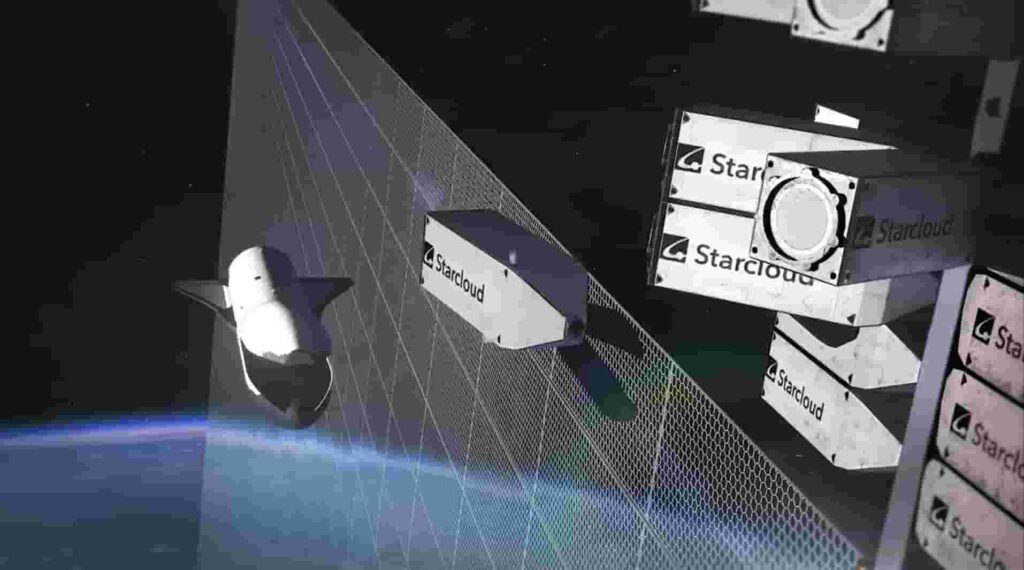
The company’s approach positions orbital compute as a complementary infrastructure layer for aerospace, defense, and commercial customers that require scalable processing capacity without terrestrial energy limitations.
Rapid Technical Progress Demonstrated Through Starcloud‑1 Mission
With only 3 million dollars in pre seed funding, Starcloud designed, built, and launched its first satellite, Starcloud 1, in 21 months. The mission achieved several industry firsts, including the first deployment of an NVIDIA H100 in orbit, the first orbital AI model training, the first orbital inference using a Gemini model, and the first demonstration of orbital fine tuning.
These milestones highlight the company’s ability to integrate advanced compute hardware, thermal management systems, and onboard processing architectures within a small satellite platform.
Funding Supports Next Generation Satellite Development and Manufacturing Scale Up
The Series A round will accelerate development of the Starcloud 3 satellite line, expand the company’s manufacturing capabilities, and support procurement of future launch contracts. Starcloud will also launch Starcloud 2 later this year, featuring a large deployable radiator and significantly increased power generation. Starcloud 2 will be the company’s first satellite to run commercial edge and cloud workloads for customers.
The company is also expanding partnerships across the aerospace and technology sectors, including early customer engagements and collaborations with major cloud and semiconductor providers.
Investor Perspective on Orbital Infrastructure Growth
Investors noted that the long term buildout of AI infrastructure will require new approaches that extend beyond terrestrial constraints. Starcloud’s engineering progress, capital efficiency, and advancements in power, cooling, and manufacturing were cited as key factors supporting the investment. The company’s ability to demonstrate complex compute operations in orbit was highlighted as a significant technical achievement.
About Starcloud
Starcloud develops orbital data centers designed to provide scalable, energy abundant compute capacity for AI and high performance processing. The company launched its first satellite, Starcloud 1, in 2025 and is headquartered in Redmond, Washington.

Related Posts